Key Takeaways
- The official test is whether it can spill, spread, spray, pump or pour. If it can, security treats it as a liquid, whatever you call it.
- Solid cheese travels free. Brie is a liquid. A jam sandwich is fine; the jar of jam is not.
- The UK is now split by airport. Heathrow, Edinburgh, Birmingham and Bristol allow containers up to 2 litres. Manchester, Stansted and Luton still cap at 100ml.
- Baby food, breast milk and medical items are exempt everywhere, in quantities above the normal limit. Declare them and have them screened separately.
- Duty-free liquids get confiscated at connections if the sealed bag has been opened. If it has, ask the security officer to re-seal it rather than surrendering the bottle.
Yes, and most food is fine. Solid food goes through security without any limit. The problem is that airport security does not divide food into "food" and "drink", it divides it into solids and liquids, and its definition of a liquid is wider than yours. The test, in the US Transportation Security Administration's own words, is whether something can "spill, spread, spray, pump, or pour". Peanut butter can. So can hummus, honey, yoghurt and soft cheese, and all of them are capped at 100ml in your hand luggage.
What food can you take through airport security?
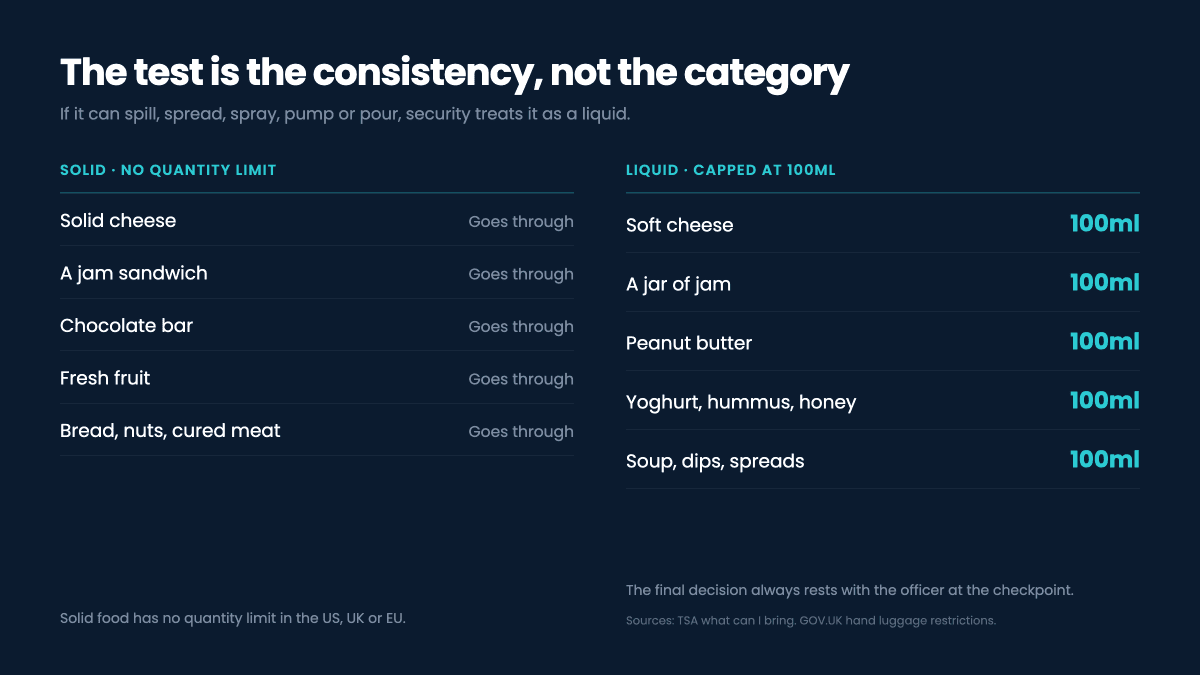
Solid food passes with no quantity limit. Liquid and semi-liquid food is capped at 100ml per container in hand luggage, in the US, the UK and the EU alike. The dividing line is not whether you eat it with a fork, it is whether it can spill, spread, spray, pump or pour.
That phrasing comes from the TSA itself, and it is the most useful sentence published on this subject, because it explains every individual ruling at once rather than making you memorise a list.
The results are counterintuitive in a specific way:
| This travels free | This is a liquid |
|---|---|
| Solid cheese | Soft and creamy cheese |
| A jam sandwich | A jar of jam |
| Chocolate | Chocolate spread |
| Fresh fruit | Yoghurt |
| Bread and baked goods | Soup |
| Dry snacks and nuts | Hummus and dips |
| Cured meat | Honey |
The sandwich rule is the clearest illustration. Jam inside a sandwich is part of a solid item and passes without comment. The same jam in a jar is a liquid and has to be under 100ml or go in your checked bag.
Which everyday foods count as liquids?
The TSA has published individual rulings on the foods people most often get wrong. Peanut butter, hummus, honey, yoghurt, jam, creamy cheese, dips and spreads, and soup are all liquids, capped at 3.4 ounces or 100ml in hand luggage. Solid cheese is a solid, with no limit.
The UK does not treat this as an American quirk. GOV.UK's own definition of liquids explicitly includes "liquid or semi-liquid foods, for example soup, jam, honey and syrups". Two jurisdictions, same logic.
One caveat matters more than any individual ruling, and it appears on every TSA item page: "The final decision rests with the TSA officer." The published rulings tell you what should happen. An officer at the checkpoint can decide otherwise about your particular container, and there is no appeal at the gate. Pack on the assumption that a borderline item may not make it.
A practical consequence: if a liquid food matters to you, whether it is a gift, a speciality item or something your child will actually eat, put it in your checked bag. The 100ml allowance is not worth gambling a jar on.
How much liquid can you take, and where?
The United States still runs the 3-1-1 rule: containers of 3.4 ounces or 100ml, in one quart-sized bag, one bag per passenger. The UK now varies by airport, with several large airports allowing containers up to 2 litres. The EU baseline remains 100ml in a 1-litre bag.
The United States
Unchanged, and simple. The scanners at larger airports have changed the process, so your bag often stays closed now, but the limit itself is the same. Two other recent changes cause confusion and neither touches food: shoes-off screening ended in July 2025, and REAL ID requirements began in May 2025.
The United Kingdom
Genuinely split, and each of these was confirmed from that airport's own page:
| Up to 2 litres | Still 100ml |
|---|---|
| Heathrow, terminals 2, 3, 4 and 5 | Manchester |
| Edinburgh | Stansted |
| Birmingham | Luton |
| Bristol | |
| Gatwick |
Two things apply UK-wide regardless of which airport you use. The clear plastic bag is no longer required at any of the airports checked. And the 2-litre allowance for medical, dietary and baby items applies everywhere, including airports that otherwise cap at 100ml.
Treat this table as a starting point rather than a guarantee. Gatwick is a live example of why: its own press release in March 2025 stated a 100ml limit, while its current passenger page states 2 litres, and there is no published date for the change. Check your departure airport's page on the day you fly, and pack for 100ml if you are connecting through somewhere you have not checked.
The European Union
The baseline is 100ml in a 1-litre bag. Scanners capable of lifting that limit were installed at a number of EU airports, then a regulation in 2024 reverted those airports to 100ml, described by the Commission as a temporary technical issue and explicitly not a response to any new threat.
The position has moved since, unevenly and without a published list of which airports are where. Schiphol's own page, for instance, still states that liquids may only be carried in containers holding a maximum of 100ml. There is no reliable EU-wide airport list, and any you find in a travel article was assembled by guesswork. Check your specific airport.
What about baby food, breast milk and medical items?
All three are exempt from the normal limits in every jurisdiction, in quantities reasonable for your trip. You must declare them at the checkpoint and they will be screened separately. You do not need to have your baby with you to carry breast milk.
| Category | United States | United Kingdom | European Union |
|---|---|---|---|
| Baby food and formula | Above 3.4oz allowed, including puree pouches | Up to 2 litres, all airports | Above 100ml, for use during the trip |
| Breast milk | Allowed, child need not be present | Up to 2,000ml, baby need not be present | Covered by the milk provision |
| Medically necessary | Reasonable quantities, exempt from the bag, declare | 2 litres, all airports | Above 100ml, may need to prove authenticity |
Two specifics worth knowing. The UK bans frozen liquids in hand luggage generally, and frozen breast milk specifically, though liquid breast milk is fine up to 2,000ml. And the UK's own guidance is internally inconsistent here: the main liquids page gives 2 litres for medical items at all airports, while the medicines sub-page says only "more than 100ml". If you are carrying a large volume of a medical liquid, carrying a prescription or a doctor's letter removes the argument.
The duty-free trap on connecting flights
Duty-free liquids bought airside travel in a sealed tamper-evident bag with the receipt inside it. The bag must stay sealed. If it has been opened before your connection, the liquid can be taken off you at the next security checkpoint.
This catches people constantly, because the bottle passed through security once and it seems settled. It is not. A connection puts you through a second checkpoint, and that checkpoint applies the rules again.
GOV.UK's wording is unusually blunt about the one thing that ruins it: "You must not open the security bag until you reach your final destination." Not until you board. Not until you are through the connection. Until you arrive.
There is a remedy that almost nobody knows about, and it is worth carrying with you. The EU's own guidance states that if the bag has been opened and you have a connecting flight at another airport, you should tell the security officer so the liquids can be re-sealed in a new security bag. So an opened bag is not automatically a lost bottle: ask before you surrender it.
So if you are buying spirits, olive oil or anything else liquid in a duty-free shop and you have a connecting flight, two things matter. Keep the bag sealed with the receipt inside it where it is visible, and if something has gone wrong with the seal, raise it at the checkpoint rather than waiting to be told.
One distinction to keep straight throughout this article: everything above concerns security screening, which is about what may pass the checkpoint. Whether a food may legally enter a country is a separate question governed by customs and agricultural rules, which differ entirely and are worth checking separately for meat, dairy and fresh produce.
Packing food for a trip
If you are travelling with dietary restrictions, or with children who will only eat specific things, the solid-versus-liquid line is the thing to plan around. Solid food is unrestricted and reliable. Anything spoonable is a gamble at 100ml and a certainty in the hold.
Navoy can factor connection times and airport transfers into a route, which matters more than it sounds when you are carrying food, since a tight connection through a second checkpoint is where duty-free purchases and borderline items get lost.
Frequently asked questions
Can you take peanut butter on a plane?
Only in containers of 100ml or less in hand luggage. The TSA classifies peanut butter as a liquid because it can spread, and the UK applies the same logic to semi-liquid foods. A full-size jar must go in your checked bag.
Can you bring a sandwich through airport security?
Yes. Sandwiches are solid food and pass with no quantity limit, including ones containing jam, chocolate spread or soft cheese. The filling only becomes a problem when it is carried separately in a jar or tub.
Can you take snacks on a plane for children?
Yes, and baby food and formula are additionally exempt from the liquid limits in quantities above the normal cap. Declare them at the checkpoint for separate screening. Solid snacks have no restrictions at all.
Will duty-free alcohol be confiscated on a connecting flight?
It can be, if the sealed security bag has been opened before you reach your final destination. If that has happened, tell the security officer at the connection: EU guidance says the liquids can be re-sealed in a new security bag rather than surrendered.
Sources
- TSA, liquids rule, the 3-1-1 requirement
- TSA, what can I bring: food, individual food rulings
- TSA, traveling with children, baby food, formula and breast milk
- GOV.UK, hand luggage restrictions: liquids, the UK definition including semi-liquid foods
- GOV.UK, baby food and baby milk
- European Commission, liquids, aerosols and gels
- UK Civil Aviation Authority, what to pack
Related articles
- How Early Should You Get to the Airport in 2026?
- ETIAS Requirements for US Travelers
- Hotel Fees That Are Not in the Price
Flying with a connection? Let Navoy build the route with transfer times that actually work.
About the Author
Haroun Moula
Haroun Moula is the founder and CEO of Navoy. Before Navoy, he worked in luxury travel with VVIPs and high-profile travelers. He built Navoy to bring curated, adaptive trip planning to more travelers through an AI travel agent that plans and books core trip parts in one place.