
Key Takeaways
- Spain leads the most recent complete ranking with 93.8 million arrivals, but that data describes 2024, not this year.
- France is missing from the official database entirely. It last reported arrivals in 2021. So have Türkiye, Thailand and the UAE.
- Four different definitions are in circulation. Switch from "tourists" to "visitors" and Poland jumps from 13th to 4th while the United States leaves the top fifteen.
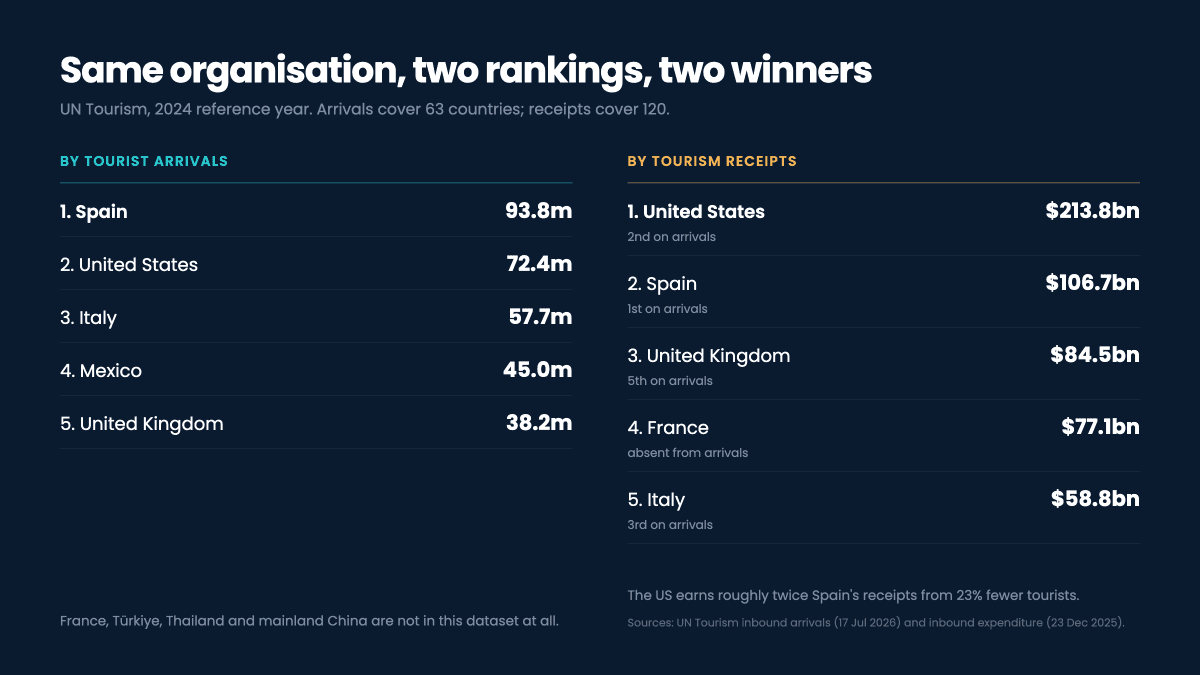
- The money ranking is the more complete one. 120 countries report tourism receipts against only 63 for arrivals, and the United States earns roughly twice Spain's receipts from 23% fewer tourists.
- Global growth has stalled. The first half of 2026 grew just 0.4%, and the full-year forecast was cut from 3 to 4% down to 1 to 2%.
Spain is the most visited country on the most recent complete figures, with 93.8 million international tourist arrivals. Two things complicate that. The figures describe 2024, because no country-level data for 2025 or 2026 has been published and none can appear before 2027. And France, normally reported as the world's busiest destination, is not in the dataset at all: it last filed arrivals figures in 2021. Every ranking you will find stitches these gaps closed from other sources, usually without saying so, and that is why no two of them agree.
Which countries are the most visited?
On UN Tourism's own database, the most recent complete year is 2024, and Spain leads it with 93.8 million international tourist arrivals, ahead of the United States on 72.4 million and Italy on 57.7 million.
These figures come from the UN Tourism Statistics Database inbound arrivals file, released on 17 July 2026. The indicator counts overnight visitors, which is what the word "tourists" means in official statistics.
| # | Country | 2024 arrivals | 2023 |
|---|---|---|---|
| 1 | Spain | 93.8m | 85.2m |
| 2 | United States | 72.4m | 66.3m |
| 3 | Italy | 57.7m | 57.2m |
| 4 | Mexico | 45.0m | 41.9m |
| 5 | United Kingdom | 38.2m | 37.2m |
| 6 | Germany | 37.4m | 34.7m |
| 7 | Austria | 32.2m | 30.9m |
| 8 | Saudi Arabia | 29.7m | 27.4m |
| 9 | Portugal | 29.0m | 26.5m |
| 10 | Hong Kong SAR | 21.9m | 17.2m |
| 11 | India | 20.4m | 18.8m |
| 12 | Canada | 19.9m | 18.3m |
| 13 | Poland | 19.7m | 19.0m |
| 14 | Macao SAR | 16.0m | 14.2m |
| 15 | Indonesia | 13.6m | 11.4m |
Two entries carry UN Tourism's own quality flags, and they are worth keeping visible. Portugal's figure is marked E for estimated. Hong Kong's is marked B for a break in the time series, meaning it is not directly comparable with earlier years.
Why is France not in that table?
Because France has not reported international arrivals to UN Tourism since 2021. Neither has Thailand or the United Arab Emirates. Türkiye last reported in 2022, Japan has no "tourists" series at all, and mainland China has no total arrivals series in the database.
The 2024 arrivals file covers 63 countries. That is a fraction of the world, and it omits several of the largest destinations. UN Tourism also carries a warning on the same spreadsheet: the data collection process is new and the system is in a "transitional phase", so some data points may not yet fully reflect the intended standards.
This is the root of the disagreement between published rankings. There is no complete, current, single-source list to copy. Anyone producing a top ten is combining the official database with national statistics offices, and those national figures use different definitions, cover different years, and are published on different schedules.
Why does every list give different numbers?
Because at least four different things get counted and all of them get called "visitors". The gap between them is not small: on the same dataset, in the same year, switching the definition moves Poland from 13th to 4th.
The official framework distinguishes visitors, which is the umbrella term, from tourists, who stay overnight, and excursionists, who are same-day visitors. The unit is also worth noticing: the database counts trips, not people, so someone who visits four times is four arrivals.
Switch the indicator from tourists to visitors in that same 2024 file and the ranking rearranges:
| Country | Rank by tourists | Rank by visitors | Visitors |
|---|---|---|---|
| Poland | 13th | 4th | 76.9m |
| Hungary | 16th | 5th | 51.2m |
| United States | 2nd | outside the top 15 |
Poland's same-day visitors outnumber its overnight tourists by almost three to one. That is land-border traffic, shopping trips and commuting, not holidays. Neither number is wrong. They answer different questions.
Then there are the national figures, each on its own basis:
- France reports about 102 million for 2025, but the French statistics directorate calls them "visiteurs internationaux". That is the umbrella term, not the overnight one. Placing 102 million French visitors beside 96.8 million Spanish tourists compares two different measurements, and it is the single most common error in published rankings.
- Türkiye reports both, and the gap is instructive: 63.94 million visitors against 52.78 million tourists for 2025. The difference is largely 11.17 million expatriate citizens returning home, who are counted as arrivals but are not tourists in any ordinary sense.
- Italy's national statistics office counts arrivals at accommodation establishments, which is a fourth basis again, and it produces different totals from the border-count approach.
So when two articles give you different numbers for the same country, neither is necessarily lying. They are usually measuring different things and not telling you which.

Which countries earn the most from tourism?
The United States, by a wide margin: 213.8 billion dollars in 2024 against Spain's 106.7 billion. And this ranking is more reliable than the arrivals one, because 120 countries report receipts while only 63 report arrivals.
| # | Country | 2024 receipts | Rank by arrivals |
|---|---|---|---|
| 1 | United States | $213.8bn | 2nd |
| 2 | Spain | $106.7bn | 1st |
| 3 | United Kingdom | $84.5bn | 5th |
| 4 | France | $77.1bn | Not in the arrivals data |
| 5 | Italy | $58.8bn | 3rd |
The contrast with the arrivals table is the interesting part. The United States earns roughly twice Spain's receipts from 23% fewer tourists, which works out at a much higher spend per visit. Mexico sits 4th on arrivals and 15th on receipts. And France appears here at 4th despite being absent from the arrivals table entirely, because it reports its money even when it does not report its visitor counts.
If your question is really "which countries does tourism matter most to", receipts answer it better than arrivals do, and the data is more complete.
What changed in 2025?
The world recorded 1,544 million international tourist arrivals in 2025, up 4.7% on 2024. That figure is provisional. The striking exception was the United States, which fell 5.5% while the world grew.
Two cautions on the headline number. It is asterisked as provisional by UN Tourism. And it is a revision upward from the 1.52 billion, +4% figure published in January 2026, so the earlier number is superseded and still circulating.
The American decline is the story of the year in the data. US arrivals fell to about 68.3 million, roughly 86% of the 2019 level, and the largest single driver was Canada, down 20.9%, which represents about 4.2 million lost visits from one market alone. Mexico moved the other way, up 6.4%.
The US tourism office expects a recovery in 2026 and names the 2026 FIFA World Cup as the driver. We looked at the travel implications of that tournament separately in why Spain's World Cup win makes 2026 the year to visit.
Where is 2026 heading?
Slower than expected. About 690 million people travelled internationally in the first half of 2026, a rise of just 0.4%, and the second quarter was actually negative. UN Tourism cut its full-year forecast from 3 to 4% growth down to 1 to 2%.
The quarterly split shows where it turned: the first quarter grew 2.0%, the second fell 0.8%. There is an independent check on this, which is unusual and worth noting. IATA reported international air traffic also up 0.4% in the first half of 2026, measured in revenue passenger kilometres. Two different organisations measuring two different things arrived at the same number.
The sharpest regional move was the Middle East, down 22% in the first half, with the Gulf states down 28.8%. UN Tourism attributes this to regional conflict and air disruption, easing after the ceasefire in May and June. For context, that region had been the fastest post-pandemic recovery anywhere, running 40% above 2019 levels in 2025. Egypt was the exception, up 3%.
Planning around the numbers
If you are choosing where to go, the useful reading of all this is that "most visited" is a poor proxy for anything you care about. It tracks border formalities and geography as much as appeal, which is why Poland's day-trippers can outrank the United States.
Navoy builds itineraries from what you actually want out of a trip rather than from a ranking, which matters most in exactly the places these tables distort.
Frequently asked questions
What is the most visited country in the world?
France is usually reported as first, but France has not filed arrivals data with UN Tourism since 2021, and its own 102 million figure counts all international visitors rather than overnight tourists. On the most recent complete official data, for 2024, Spain leads with 93.8 million tourist arrivals.
Why do different websites give different visitor numbers?
Because they measure different things. Official statistics separate overnight tourists from same-day visitors, and some countries report only one of the two. National figures also use different bases, such as border counts versus hotel registrations, and cover different years.
Is there 2026 data for the most visited countries?
No, and there cannot be until 2027. Country-level arrivals are published with a substantial lag: the most recent complete country data is 2024. Only world and regional totals exist for 2025, and only partial growth rates for the first half of 2026.
Which country earns the most from tourism?
The United States, with 213.8 billion dollars in receipts in 2024, ahead of Spain on 106.7 billion. The receipts ranking covers 120 countries against 63 for arrivals, so it is the more complete measure of the two.
Sources
- UN Tourism, World Tourism Barometer, the 2025 world total and the H1 2026 figures, version 15 September 2026
- UN Tourism Statistics Database, inbound arrivals file, released 17 July 2026, the 2024 country ranking
- UN Tourism Statistics Database, inbound expenditure file, released 23 December 2025, the receipts ranking
- INE, FRONTUR, Spain's 2025 arrivals, published 3 February 2026
- DGE, French tourism data, France's 2025 international visitor figure
- TurkStat, Türkiye's 2025 tourists and visitors, published around 30 January 2026
- US National Travel and Tourism Office, US arrivals and the 2026 forecast
Related articles
- Why Spain's World Cup Win Makes 2026 the Year to Visit
- The Cheapest Digital Nomad Visa Countries in 2026
- How Much Are Tourist Taxes in 2026?
Picking a destination? Let Navoy plan it around what you want, not what a ranking says.
About the Author
Ranym Garali
Ranym is the Marketing and Content Lead at Navoy. She's been writing about travel for two years and digs into the data behind each piece, flight prices, visa rules and what people are actually searching for , so the advice holds up in practice.