

Key Takeaways
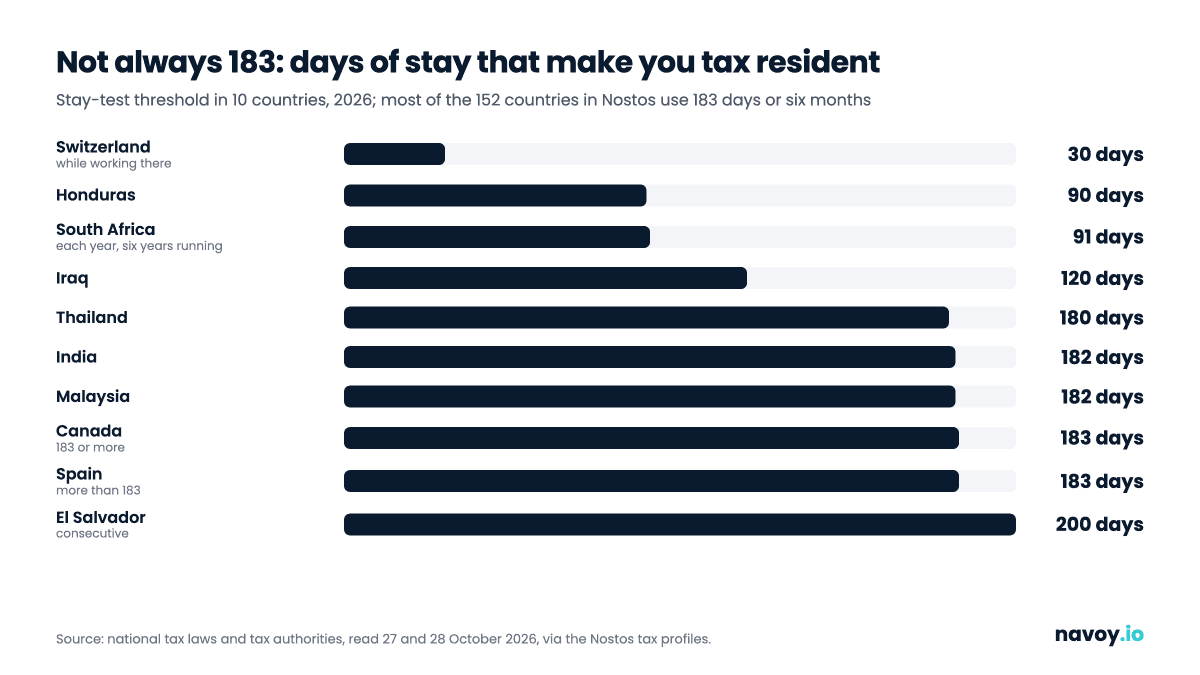
- The 183-day rule is common, not universal. Of the 152 countries in Nostos, 112 use a half-year test (183 days, or six months in places like Germany and Sweden), 13 use a different number (from 30 days in Switzerland to one year in Japan) and 27 have no length-of-stay test at all.
- The counting window matters as much as the number. Spain counts more than 183 days in a calendar year, Portugal and New Zealand any 12 months, and the UK a tax year from 6 April to 5 April, so the same trip can make you resident in one country and not another.
- A home can make you resident on day one. Germany, Portugal, Canada and the Netherlands can treat you as resident from the day you move into a home you mean to keep, long before day 183.
- Mexico has no 183-day rule. Mexican law makes you resident if your home is in Mexico, or, with homes in two countries, if your centre of vital interests is there.
- When two countries both claim you, a tax treaty decides. The usual tie-breakers look at your permanent home, then your centre of vital interests, then where you habitually live, then your nationality.
The 183-day rule says that if you spend more than about half a year in a country, you become its tax resident and owe tax on your worldwide income. It is the most common test, but not a universal one. Of the 152 countries in the Nostos tax profiles, 112 use a half-year test (183 days or six months), 13 use a different number, and 27 have no length-of-stay test at all. Many countries can also make you resident from the first day you move into a home.
Everything below is as of October 2026, from each country's tax law or tax authority, compiled in the free Nostos dataset. Rules verified against official sources on 27 and 28 October 2026. It is general information, not tax advice. If you are a US citizen, you are taxed on worldwide income wherever you live, and your home country's own exit rules can keep you resident there, so check both sides with a qualified adviser.
Is the 183-day rule the same in every country?
No. Here is how the 152 countries split, based on the residence rule in each profile (a stay test means a length of stay that makes you resident on its own):
| What the law counts | Countries | Examples |
|---|---|---|
| Half a year: 183 days or six months | 112 | Spain, Portugal, Canada, Germany, Colombia, Vietnam |
| A different number of days or months | 13 | Switzerland, South Africa, Thailand, India, Japan |
| No length-of-stay test at all | 27 | Mexico, Netherlands, Belgium, Senegal, Paraguay, Bahamas |
Even inside the 112, "more than 183 days" (Spain, Portugal, Brazil) means day 184 makes you resident, while "183 days or more" (Canada, China, the UK) means day 183 is enough. Seven count months: Austria, Denmark, Finland, Germany, Sweden and Türkiye need six months in a row, and France treats over six months in a year as an indicator. Laos taxes foreigners paid from abroad after more than 183 days.
Counting days for a long stay? Plan the trip free with Navoy and compare hotels in Mexico City.
Which countries use a number other than 183?
The 13 exceptions:
- Switzerland, 30 or 90 days. You have a tax stay if you are in Switzerland at least 30 days while working, or at least 90 days without working, ignoring short trips away (DBG article 3). Remote work counts as working.
- Honduras, 90 days. More than three months in the calendar year.
- South Africa, 91 days over six years. The physical presence test needs more than 91 days in the current tax year, more than 91 in each of the five previous years and more than 915 days across those five. You are then resident from the first day of the sixth year. Separately, you are resident from arrival if South Africa becomes your real home ("ordinarily resident").
- Iraq, 120 days. Four continuous months, or six months in total, in the year.
- Thailand, 180 days. Section 41 of the Revenue Code says 180 days or more in a calendar year; the Revenue Department's English summary page says more than 180.
- Hong Kong, Nicaragua and the Philippines, 180 days. In Hong Kong and the Philippines the line mostly sets how local income is taxed.
- India and Malaysia, 182 days. India uses an April to March tax year; Malaysia the calendar year.
- El Salvador, 200 days. More than 200 consecutive days in a calendar year.
- Argentina, 12 months. A foreigner on temporary permits becomes resident after 12 months living there; absences of up to 90 days per 12 months do not break the count.
- Japan, one year. One year of continuous living there, or sooner with a domicile or a year-long job.
Which countries have no day count at all?
The 27 countries without a length-of-stay test fall into five groups:
- Home and life tests (7): Aruba, Belgium, Curaçao, Luxembourg, Mexico, the Netherlands and Suriname. Luxembourg may also apply a six-month habitual-abode rule, which we could not confirm on the official text.
- Domicile or main-stay tests (8): Algeria, Cameroon, Côte d'Ivoire, French Polynesia, Mozambique, New Caledonia, Senegal and Togo. In all but Côte d'Ivoire, working from the country as your main activity can make you domiciled; in Senegal that can apply from the first day (CGI article 48).
- Source-based systems (5): Angola, Bolivia, Namibia, Syria and Zimbabwe.
- Status or nationality (3): Cuba and Paraguay tie residence to permanent residence under immigration law; Iran taxes by nationality.
- No personal income tax (4): the Bahamas, Bahrain, Kuwait and Vanuatu.
The 183-day rule in Mexico
Mexico is the clearest example. Article 9 of the Federal Tax Code makes you resident if you have established your home (casa habitación) in Mexico. If you also have a home abroad, you are resident only if your centre of vital interests is in Mexico, for example when more than 50% of your income for the calendar year comes from Mexican sources. There is no day count. A home you rent in Mexico City is likely to count as casa habitación; a tourist rental with your vital interests abroad is not.

When can a home make you resident from day one?
In many 183-day countries the day count is only the backstop:
- Germany: a home (Wohnsitz) you hold in circumstances showing you will keep and use it makes you fully taxable from the day you move in (AO § 8). A continuous stay of more than six months is also a habitual abode from its first day (AO § 9). See Berlin.
- Portugal: a home you keep as your habitual residence on any day of the period makes you resident, and residence starts on your first day. A D8 visa holder who rents long term in Lisbon is normally resident from arrival.
- Canada: you are a factual resident from the day you set up significant residential ties: a home, a spouse or common-law partner, or dependants, according to the Canada Revenue Agency. See Toronto.
- The Netherlands: the Belastingdienst treats you as a resident taxpayer from the day you move. Renting a long-term home in Amsterdam and settling in usually counts; a holiday rental normally does not.
- Switzerland: living there with the intention of staying permanently creates a tax domicile from the first day, with no day count. See Zurich.
- Kenya: with a permanent home in Kenya, being present for any period in the year makes you resident, and "permanent home" includes any place available to you for living. Someone renting in Nairobi for a year should expect to be resident from the year of arrival.
- Nigeria: any one of six tests is enough, including a permanent place available for your domestic use, so a newcomer who rents a flat in Lagos is likely resident from the year of arrival.
The UAE, Indonesia, Vietnam, Morocco and Chile also have home, lease or intention tests that can apply before day 183.
Calendar year, tax year or any 12 months: which window counts?
The number of days only matters with the window it is counted in: the calendar year (Spain, Canada, Thailand), a tax year that is not the calendar year (the UK from 6 April, India from April, Australia from 1 July), or any 12 months, a rolling window (Portugal, Greece, New Zealand, Chile). The table below gives the window for 30 countries.
One trip, four answers
Take a nomad who arrives on 1 September 2026 and leaves on 31 March 2027: 212 days, with 122 in 2026 and 90 in 2027.
- Spain: never more than 183 days in one calendar year, so the day test is not met (the economic-interests test can still apply).
- Thailand: under 180 days in each calendar year, so non-resident in both.
- Portugal: day 184 falls on 3 March 2027, inside a 12-month window, so you are resident, counted from your first day.
- UK: all 212 days fall inside the 2026 to 2027 tax year, so the 183-day automatic test is met.
Türkiye adds a twist: its six months must be continuous and within one calendar year, so a July to June stay never passes the day test.
How do you count your days (a manual 183-day calculator)?
Before you trust any 183-day calculator, set it up the way the country counts:
- Pick the right window. Calendar year, the country's tax year, or every 12-month period that starts or ends in the year.
- Check how a day is defined. Colombia, Chile and Vietnam count arrival and departure days. The US and New Zealand count any part of a day. The UK counts a day if you are there at midnight. China counts only full 24-hour days for people without a domicile.
- Check absences. Spain counts sporadic absences as days in Spain unless you prove tax residence elsewhere.
- Check for backdating. New Zealand backdates residence to the first of the 183 days, and Greece makes you resident from your first day. Peru does the opposite: crossing 183 days makes you resident only from the next 1 January.
- Check multi-year tests. The US adds a third of last year's days and a sixth of the year before's; South Africa looks back five years.
New Zealand has a carve-out: for arrivals from 1 April 2026, a non-resident visitor can spend up to 275 days in any 18 months without the 183-day rule applying, if they stay tax resident elsewhere and work only for foreign employers or clients, with no New Zealand customers, though a permanent place of abode still counts. See Auckland.
What happens when two countries both claim you?
You can end up resident in two places in the same year. A double tax treaty then decides with a fixed order of tie-breakers: first where you have a permanent home, then your centre of vital interests (personal and economic ties), then where you habitually live, then your nationality. The treaty result overrides domestic law: Canada deems you non-resident if a treaty gives your residence to the other country, South Africa does the same, and in the US a dual resident claims treaty non-residence on Form 1040-NR with Form 8833. Treaties exist only between pairs of countries, so check that one applies before relying on it.
The 183-day rule in 30 nomad countries
The 29 countries with the most cities in Nostos (10 or more each) plus Peru, alphabetical. Each city page, such as Cape Town, shows the full tax section.
| Country | Day count | Window | Other tests that can apply sooner |
|---|---|---|---|
| Argentina | 12 months | Living there on temporary permits | Permanent residence, from the next month |
| Australia | More than half the income year | Income year, 1 July to 30 June | Resides test (a 12-month lease likely counts); domicile |
| Brazil | 184th day | Up to 12 months | Permanent visa or Brazilian job, from arrival |
| Canada | 183 days or more | Calendar year | Home, spouse or dependants, from that day |
| Chile | More than 183 days | Any 12 months | Domicile: living there with intent to stay |
| China | 183 days or more (full days only) | Calendar year | Domicile: household registration, family, economic ties |
| Colombia | More than 183 days | Any 365 days | None for foreigners |
| France | More than six months (an indicator) | Calendar year | Home, main professional activity, economic interests |
| Germany | More than six months, continuous | Any stay, can span two years | A home you keep and use, from move-in |
| Greece | More than 183 days | Any 12 months | Main residence, habitual abode, vital interests |
| India | 182 days, or 60 plus 365 in 4 prior years | Tax year, April to March | None |
| Indonesia | More than 183 days | Any 12 months | Home, or intent to reside (ITAS or lease over 183 days) |
| Italy | 183 days (184 in a leap year) | Calendar year | Habitual residence, domicile, registry |
| Japan | One year of living there | Continuous | Domicile; a job needing a year or more |
| Malaysia | 182 days or more | Calendar year, with linked periods | 90 days plus 3 of the 4 previous years |
| Mexico | None | None | Home; centre of vital interests |
| Morocco | More than 183 days | Any 365 days | Permanent home; centre of economic interests |
| Netherlands | None | None | All circumstances, from the day you move |
| New Zealand | More than 183 days | Any 12 months, backdated | Permanent place of abode |
| Peru | More than 183 days | Any 12 months, effective next 1 January | None |
| Philippines | More than 180 days (sets the rate) | Calendar year | Residence judged on facts and intent |
| Portugal | More than 183 days | Any 12 months | Home kept as habitual residence, from day one |
| South Africa | Over 91 days a year for 6 years, 915 in 5 | Tax year, March to February | Ordinarily resident (real home) |
| Spain | More than 183 days | Calendar year | Economic interests; spouse and children presumption |
| Sri Lanka | 183 days or more | Any 12 months, backdated | "Resides" (not defined) |
| Thailand | 180 days | Calendar year | None |
| Türkiye | More than six months, continuous | Within one calendar year | Domicile (intent to settle) |
| United Kingdom | 183 days or more | Tax year, 6 April to 5 April | UK home, full-time UK work, or ties from 46 days |
| United States | 183 weighted days (at least 31 this year) | Calendar year plus 2 prior years | Green card; citizens taxed wherever they live |
| Vietnam | 183 days or more | Calendar year or 12 months from arrival | Residence card, or leases (hotels too) totaling 183 days |
Sources: each country's tax law or tax authority, read on 27 and 28 October 2026, compiled in the Nostos tax profiles.
How to use this when planning a year abroad
Treat 183 days as a ceiling to watch, not a safe harbor: check the window, whether a lease changes the answer, and whether your home country still treats you as resident. For a wider look at which nomad visas carry special tax rules, read which digital nomad visas make you pay tax, and if you are counting Schengen days too, see the Schengen 90/180 rule guide. Once you have a shortlist, plan the trip free with Navoy, then compare hotels in Mexico City and flights to Mexico City.
Frequently asked questions
Does the 183-day rule apply in every country?
No. In the 152 country tax profiles in Nostos, 112 countries use a half-year test (183 days, or six months in countries such as Germany and Sweden), 13 use a different number, such as 30 working days in Switzerland, 180 days in Thailand or 182 days in India, and 27 have no length-of-stay test at all. Many of the half-year countries also make you resident sooner if you keep a home there or move your family or economic life there.
What is the 183 day rule in Spain?
You are a Spanish tax resident for the whole calendar year if you spend more than 183 days in Spain during it, or if the main centre of your activities or economic interests is in Spain. You are also presumed resident if your spouse and dependent minor children live there. Sporadic absences count as days in Spain unless you prove tax residence in another country.
Is there a 183 day rule in Canada?
Yes, but it is the second test, not the first. You become a factual resident from the day you set up significant residential ties, such as a home, a spouse or common-law partner, or dependants in Canada. Without those ties, staying 183 days or more in a calendar year makes you a deemed resident for the whole year.
Do arrival and departure days count toward 183 days?
It depends on the country. Colombia, Chile and Vietnam count both days, the US and New Zealand count any part of a day, the UK counts a day only if you are there at midnight, and China counts only full 24-hour days for people without a Chinese domicile. Check the rule of each country you visit before you plan a stay close to the limit.
Sources
- Ley 35/2006, del Impuesto sobre la Renta de las Personas Físicas (texto consolidado), article 9, Agencia Estatal Boletín Oficial del Estado (Spain), https://www.boe.es/buscar/act.php?id=BOE-A-2006-20764, accessed 2026-10-27
- Código Fiscal de la Federación, article 9, Cámara de Diputados del H. Congreso de la Unión (Mexico), https://www.diputados.gob.mx/LeyesBiblio/pdf/CFF.pdf, accessed 2026-10-27
- Determining your residency status, Canada Revenue Agency, https://www.canada.ca/en/revenue-agency/services/tax/international-non-residents/information-been-moved/determining-your-residency-status.html, accessed 2026-10-28
- Bundesgesetz über die direkte Bundessteuer (DBG), SR 642.11, article 3, Swiss Federal Chancellery (Fedlex), https://www.fedlex.admin.ch/eli/cc/1991/1184_1184_1184/de, accessed 2026-10-28
- Tax residency status for individuals, Inland Revenue (New Zealand), https://www.ird.govt.nz/international-tax/individuals/tax-residency-status-for-individuals, accessed 2026-10-28
- Act commentary: Taxation (Annual Rates for 2025-26, Compliance Simplification, and Remedial Measures) Act 2026, Inland Revenue Tax Technical (New Zealand), https://www.taxtechnical.ird.govt.nz/-/media/project/ir/tp/publications/2026/compliance-simplification-bill-act-commentary.pdf?modified=20260527230501, accessed 2026-10-27
- Revenue Code, Chapter 3 Income Tax, section 41, The Revenue Department of Thailand, https://www.rd.go.th/english/37749.html, accessed 2026-10-28
- Personal Income Tax, The Revenue Department of Thailand, https://www.rd.go.th/english/6045.html, accessed 2026-10-28
- Código do IRS, artigo 16.º (Residência), Autoridade Tributária e Aduaneira, Portal das Finanças (Portugal), https://info.portaldasfinancas.gov.pt/pt/informacao_fiscal/codigos_tributarios/cirs_rep/Pages/irs16.aspx, accessed 2026-10-27
- Abgabenordnung (AO) § 8 Wohnsitz, Federal Ministry of Justice, gesetze-im-internet.de (Germany), https://www.gesetze-im-internet.de/ao_1977/__8.html, accessed 2026-10-27
- Abgabenordnung (AO) § 9 Gewöhnlicher Aufenthalt, Federal Ministry of Justice, gesetze-im-internet.de (Germany), https://www.gesetze-im-internet.de/ao_1977/__9.html, accessed 2026-10-27
- Persönliche Steuerpflicht, Bundesministerium für Finanzen (Austria), https://www.bmf.gv.at/themen/steuern/arbeitnehmerveranlagung/allgemeines-zur-lohn-und-einkommenssteuer/persoenliche-steuerpflicht.html, accessed 2026-10-27
- Tax liability in Denmark: Full and limited tax liability, Danish Tax Agency, https://skat.dk/en-us/individuals/taxation-in-denmark/tax-liability, accessed 2026-10-27
- Skattskyldighet, Skatteverket (Sweden), https://www.skatteverket.se/privat/skatter/arbeteochinkomst/sabeskattasdinlon/skattskyldighet.4.65fc817e1077c25b8328000206.html, accessed 2026-10-27
- Law on Income Tax (amended) No 88/NA of 25 June 2025, article 32, Lao Official Gazette, https://www.laoofficialgazette.gov.la/kcfinder/upload/files/88-25-6-2025_0001.pdf, accessed 2026-10-27
- Immigration checklist - what do I need to know?, Belastingdienst (Netherlands), https://www.belastingdienst.nl/wps/wcm/connect/en/individuals/content/immigration-checklist-what-do-i-need-to-know, accessed 2026-10-27
- Algemene wet inzake rijksbelastingen, artikel 4, Overheid.nl (Netherlands), https://wetten.overheid.nl/BWBR0002320/2026-01-01, accessed 2026-10-27
- Income Tax Act (Cap. 470), section 2, consolidated to 1 July 2026, Kenya Law, https://kenyalaw.org/akn/ke/act/1973/16/eng@2026-07-01, accessed 2026-10-27
- Nigeria Tax Act, 2025 (Act No. 7), section 202, Official Gazette No. 117, Federal Government of Nigeria (hosted by the Lagos State Internal Revenue Service), https://lirs.gov.ng/assets/docs/Gazette%20-%20NIGERIA%20TAX%20ACT,%202025.pdf, accessed 2026-10-27
- Interpretation Note 4 (Issue 5): Resident, physical presence test, South African Revenue Service, https://www.sars.gov.za/wp-content/uploads/Legal/Notes/LAPD-IntR-IN-2012-04-Resident-definition-natural-person-physical-presence.pdf, accessed 2026-10-27
- Interpretation Note 3 (Issue 2): Resident, ordinarily resident, South African Revenue Service, https://www.sars.gov.za/wp-content/uploads/Legal/Notes/LAPD-IntR-IN-2012-03-Resident-definition-natural-person-ordinarily-resident.pdf, accessed 2026-10-27
- Guidance note for Statutory Residence Test (RDR3), HM Revenue & Customs, https://www.gov.uk/government/publications/rdr3-statutory-residence-test-srt/guidance-note-for-statutory-residence-test-srt-rdr3, accessed 2026-10-27
- RFIG20710, Statutory Residence Test: meaning of a day spent in the UK, HM Revenue & Customs, https://www.gov.uk/hmrc-internal-manuals/residence-and-fig-regime-manual/rfig20710, accessed 2026-10-28
- Substantial presence test, Internal Revenue Service, https://www.irs.gov/individuals/international-taxpayers/substantial-presence-test, accessed 2026-10-27
- The Income-tax Act, 2025 (No. 30 of 2025), Gazette of India, https://egazette.gov.in/WriteReadData/2025/265620.pdf, accessed 2026-10-27
- Tax Treatment: Residents & Non-Residents (update 08/04/2026), Inland Revenue Board of Malaysia, https://www.hasil.gov.my/wp-content/uploads/Tax-Treatment-Residents-Non-Residents.pdf, accessed 2026-10-27
- Your tax residency, Australian Taxation Office, https://www.ato.gov.au/individuals-and-families/coming-to-australia-or-going-overseas/your-tax-residency, accessed 2026-10-27
- Residence for tax purposes, Agenzia delle Entrate (Italy), https://www.agenziaentrate.gov.it/portale/web/english/residence-for-tax-purposes, accessed 2026-10-27
- BOI-IR-CHAMP-10: Personnes imposables et domicile fiscal, DGFiP, BOFiP-Impôts (France), https://bofip.impots.gouv.fr/bofip/1911-PGP.html/identifiant=BOI-IR-CHAMP-10-20160728, accessed 2026-10-27
- Κώδικας Φορολογίας Εισοδήματος (ν. 4172/2013), article 4, Ministry of National Economy and Finance (Greece), https://minfin.gov.gr/wp-content/uploads/2026/04/%CE%9A%CE%A9%CE%94%CE%99%CE%9A%CE%9F%CE%A0%CE%9F%CE%99%CE%97%CE%A3%CE%97-%CE%A4%CE%9F%CE%A5-%CE%9A%CE%A9%CE%94%CE%99%CE%9A%CE%91-%CE%A6%CE%9F%CE%A1%CE%9F%CE%9B%CE%9F%CE%93%CE%99%CE%91%CE%A3-%CE%95%CE%99%CE%A3%CE%9F%CE%94%CE%97%CE%9C%CE%91%CE%A4%CE%9F%CE%A3-%CE%9C%CE%95%CE%A7%CE%A1%CE%99-%CE%A4%CE%9F-%CE%9D-5264-2025.pdf, accessed 2026-10-27
- Estatuto Tributario, artículos 9 y 10, DIAN (Colombia), https://normograma.dian.gov.co/dian/compilacion/docs/estatuto_tributario.htm#10, accessed 2026-10-27
- Perguntas e Respostas IRPF 2026 (versão 1.00), Receita Federal do Brasil, https://www.gov.br/receitafederal/pt-br/centrais-de-conteudo/publicacoes/perguntas-e-respostas/dirpf/p-r-irpf-2026-v1-00-2026-04-23.pdf, accessed 2026-10-27
- Ley de Impuesto a las Ganancias, texto ordenado en 2019, article 116, ARCA Biblioteca Electrónica (Argentina), https://biblioteca.afip.gob.ar/dcp/LEY_C_020628_2019_12_05, accessed 2026-10-27
- Decreto 862/2019, Reglamentación de la Ley de Impuesto a las Ganancias, article 281, ARCA Biblioteca Electrónica (Argentina), https://biblioteca.afip.gob.ar/dcp/DEC_C_000862_2019_12_06, accessed 2026-10-28
- Circular N° 63 de 2021 (residencia y domicilio), Servicio de Impuestos Internos (Chile), https://www.sii.cl/normativa_legislacion/circulares/2021/circu63.pdf, accessed 2026-10-27
- Individual Income Tax Law of the People's Republic of China, article 1, State Taxation Administration, https://fgk.chinatax.gov.cn/zcfgk/c100009/c5193028/content.html, accessed 2026-10-27
- Decree No 253/2026/ND-CP detailing the Law on Personal Income Tax, Official Gazette of Vietnam, https://congbao.chinhphu.vn/van-ban/nghi-dinh-so-253-2026-nd-cp-469959.htm, accessed 2026-10-27
- Peraturan Direktur Jenderal Pajak PER-23/PJ/2025, Direktorat Jenderal Pajak (Indonesia), https://pajak.go.id/id/node/118835, accessed 2026-10-27
- Income Tax Law No 193, articles 3 to 5, Mevzuat Bilgi Sistemi (Türkiye), https://www.mevzuat.gov.tr/mevzuatmetin/1.4.193.pdf, accessed 2026-10-27
- Code Général des Impôts, article 23, Direction Générale des Impôts (Morocco), https://tax.gov.ma/wps/wcm/connect/30b7372b-68d0-462f-b40b-bd5c9f642a26/CGI+2021+version+fran%C3%A7aise.pdf?MOD=AJPERES&CACHEID=ROOTWORKSPACE-30b7372b-68d0-462f-b40b-bd5c9f642a26-nryAoP4, accessed 2026-10-27
- Texto Único Ordenado de la Ley del Impuesto a la Renta, Capítulo II, SUNAT (Peru), https://www.sunat.gob.pe/legislacion/renta/ley/capii.pdf, accessed 2026-10-27
- Inland Revenue Act No 24 of 2017, consolidated, sections 69 and 70, Inland Revenue Department (Sri Lanka), https://www.ird.gov.lk/en/publications/Acts_Income%20Tax_2017/IRA_Cons_Act_-_2025_Changes.pdf, accessed 2026-10-27
- No.2875 居住者と非居住者の区分, National Tax Agency (Japan), https://www.nta.go.jp/taxes/shiraberu/taxanswer/gensen/2875.htm, accessed 2026-10-27
- National Internal Revenue Code of 1997, as amended, sections 22 and 25, Bureau of Internal Revenue (Philippines), https://www.bir.gov.ph/tax-code, accessed 2026-10-27
- A guide to Salaries Tax for people coming to work in Hong Kong (PAM 42(e), April 2026), Inland Revenue Department (Hong Kong), https://www.ird.gov.hk/eng/pdf/pam42e.pdf, accessed 2026-10-28
- Ley del Impuesto sobre la Renta, Decreto-Ley 25 (consolidated), Servicio de Administración de Rentas (Honduras), https://www.sar.gob.hn/download/texto-consolidado-decreto-ley-numero-25-ley-del-impuesto-sobre-la-renta/, accessed 2026-10-27
- Reglamento de la Ley del Impuesto sobre la Renta, Acuerdo 799 of 1969, article 15, official text reproduced by Honduras eRegulations (UNCTAD), https://honduras.eregulations.org/media/HondurasRreglamentoLISR.pdf, accessed 2026-10-27
- Income Tax Law No 113 of 1982 (consolidated Arabic text), General Commission of Taxes (Iraq), https://tax.mof.gov.iq/%D9%82%D8%A7%D9%86%D9%88%D9%86-%D8%B6%D8%B1%D9%8A%D8%A8%D8%A9-%D8%A7%D9%84%D8%AF%D8%AE%D9%84-%D8%B1%D9%82%D9%85-113-%D9%84%D8%B3%D9%86%D8%A9-1982-%D9%88%D8%AA%D8%B9%D8%AF%D9%8A%D9%84%D8%A7%D8%AA%D9%87/, accessed 2026-10-27
- Ley de Impuesto sobre la Renta, Decreto Legislativo 134 of 1991 (consolidated), Asamblea Legislativa de El Salvador, https://www.asamblea.gob.sv/sites/default/files/documents/decretos/F7E4B567-1749-45F4-96BB-748A01BF4D14.pdf, accessed 2026-10-28
- Tuloverolaki 1535/1992 (Income Tax Act), section 11, Finlex (Finland), https://www.finlex.fi/fi/lainsaadanto/1992/1535, accessed 2026-10-27
- Code général des impôts du Sénégal, article 48, Direction générale des Impôts et des Domaines, https://www.dgid.sn/storage/docs/CGI-2025.pdf, accessed 2026-10-27
- Decreto N° 3181/2019, Annex article 2, Dirección Nacional de Ingresos Tributarios (Paraguay), https://www.dnit.gov.py/documents/47797/47809/Decreto+N%C2%B0+3181-19.pdf/1382f732-af6b-de2a-0fe3-8ce02a0eb2ff?t=1681424114127, accessed 2026-10-27
- Tax Resident and Tax Residency Certificate Tax Procedures Guide (TPGTR1), Federal Tax Authority (UAE), https://tax.gov.ae/Datafolder/Files/Guides/VAT/VAT%20Guides/Tax-Resident-and-TRC--18-10-2024.pdf, accessed 2026-10-27
- Nostos tax profiles (152 countries), Navoy, https://nostos.navoy.io/data, accessed 2026-10-28
About the Author
Ranym Garali
Ranym is the Marketing and Content Lead at Navoy. She's been writing about travel for two years and digs into the data behind each piece, flight prices, visa rules and what people are actually searching for , so the advice holds up in practice.


